
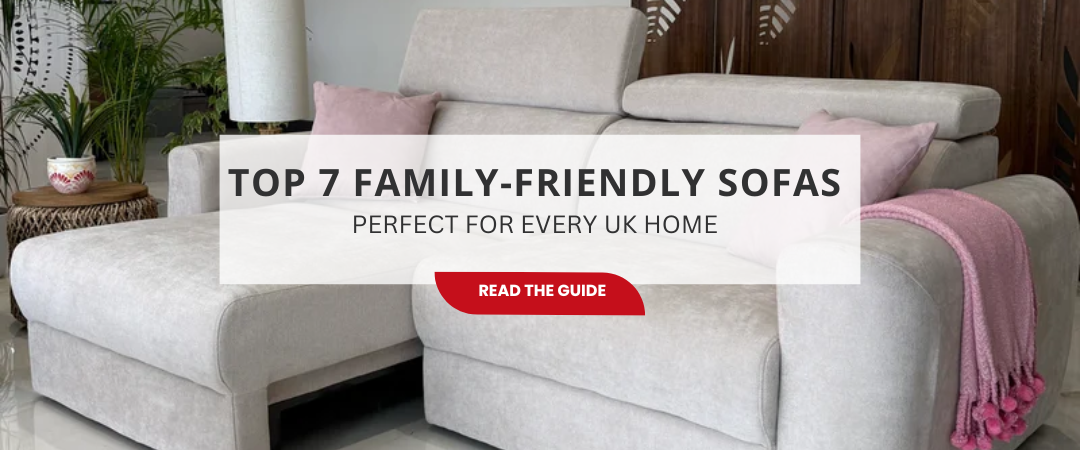
Top 7 Family-Friendly Sofas Perfect for Every UK Home
A sofa in a family home doesn't get an easy life. It's the breakfast spot on a school morning, the sick bay when someone's off with a cold, the trampoline nobody admitted to, and – eventually – where the adults collapse once the house goes quiet. If you're searching for family sofas in the UK, you're really asking a different question to someone furnishing a show home: which sofa will still look decent and feel comfortable after five years of real life?
This guide runs through the seven sofa types that consistently hold up best in busy households, with honest notes on where each one works and where it doesn't. Every type below is available in our full sofa collection, so you can compare styles and fabrics once you've narrowed things down.
What makes a sofa family-friendly in the first place?
Before the list, it's worth being clear about what we're judging. A family-friendly sofa isn't one particular shape. It's a combination of five things:
- Seating that flexes. Two adults and a toddler one year, two teenagers and their friends the next. The sofa needs to cope with both.
- Fabric that survives. Juice, felt tips, muddy dog paws and the occasional nappy incident. Fabric choice matters more than frame style for most families.
- Cushions you can lift. Removable, reversible seat cushions let you flip a stain away and share the wear evenly.
- A footprint that fits. UK living rooms are not large. Research by LABC Warranty puts the average new-build living room at just 17.09 square metres, down from nearly 25 square metres in the 1970s. A sofa that overwhelms the room makes daily life harder, not easier.
- Somewhere for the stuff. Storage, whether in a matching footstool or built into the sofa itself, keeps blankets, remotes and toys out of sight.
With that in mind, here are the seven sofa types we'd point a family towards, in roughly the order we get asked about them in the showroom.
1. Corner sofas – the all-rounder for most family living rooms
If we had to recommend one sofa type for the majority of UK families, it would be the corner sofa. The L-shape does something a straight sofa can't: it seats five or six people while only taking up two walls, leaving the middle of the room free for floor play, a coffee table or a dog bed.
The chaise end is the part families tend to fall in love with. It's wide enough for a parent and two children to share a film, or for one adult to stretch out fully on a Sunday afternoon. And because most corner sofas come in left-hand and right-hand versions, you can usually make one work around a doorway, radiator or bay window.
Best for: households of three to five, medium-sized living rooms, anyone who hosts regularly.
Watch out for: corner sofas are less forgiving of a badly measured room than a straight sofa. Measure the wall lengths including skirting and radiators, and check the depth of the chaise – some run deeper than 1.6 metres, which can block a walkway in a narrower lounge.
2. U-shaped sofas – for larger families and open-plan homes
Where a corner sofa has one chaise, a U-shaped sofa has two arms coming forward, creating a seating pit that everyone faces into. That layout is brilliant for families because it turns the sofa into a shared space rather than a row of people staring at a screen.
or six, a U-shaped sofa is often the only single piece that seats everyone without pulling in dining chairs.
Best for: larger families, open-plan kitchen-living spaces, homes where the sofa doubles as the main social area.
Watch out for: you'll need floor space on three sides to walk around it comfortably. In a standard terraced front room a U-shape can dominate; in an open-plan extension it can define the living zone beautifully. If you're on the fence, our Manchester showroom has several on display so you can sit in one before committing.
See the current range of U-shaped sofas, including modular options you can reconfigure as the family grows.
3. Reclining sofas – comfort for parents, novelty for kids
Reclining sofas have shed their old "gadget" image. Modern versions come in slimline designs with power or manual mechanisms, and they solve a very specific family problem: the adult who wants to properly relax in the evening without heading upstairs to bed.
They're also popular with families who have a grandparent living with them or visiting often. An electric recliner is far easier to get out of than a deep, low sofa, and the footrest support helps with circulation for anyone who spends long periods sitting.
The children, of course, treat the reclining mechanism as entertainment. Which is fine, as long as you choose a well-built model – the mechanism is the component that wears first, so it's worth checking the warranty terms and, if you can, testing it in person.
Best for: multi-generational households, parents who value evening comfort, anyone with back or mobility concerns.
Explore our reclining sofas in two-, three- and corner configurations.
Also read: Sofa Buying Guide for UK Homes
4. Sofa beds – the spare room you don't have
Ask a family with young children what their living room needs to do, and "sleep a grandparent at Christmas" or "host a school friend for a sleepover" will come up more often than you'd expect. A sofa bed gives you that flexibility without sacrificing a bedroom.
The important thing is to buy a sofa bed as a sofa first. If it's going to be sat on every single day and slept on ten nights a year, the seat comfort and fabric matter more than the mattress. Corner sofa beds and click-clack styles each suit different rooms – we've covered the differences in detail in our guide to sofa beds for everyday use.
Best for: families who host overnight guests, smaller homes without a spare room, playrooms that double as guest rooms.
Watch out for: the folding mechanism means the fabric gets flexed and rubbed far more than on a fixed sofa. Aim for a higher abrasion rating than you'd otherwise consider (see the fabric section below).
Browse sofa beds or, for the largest families, our U shape sofa beds that combine full-width seating with a proper pull-out bed.
5. 4 seater sofas – the straight-line solution for wider rooms
Not every family wants a corner. If your living room is long and narrow, or you've got a large picture window along one wall, a straight 4 seater sofa can seat almost as many people as a corner unit while keeping the room feeling open.
Four-seaters also pair well with a couple of armchairs or a snuggle chair opposite, creating the classic "conversation" layout that works for families with older children who each want their own spot. And because there's no chaise, there's nothing to trip over when the room is in toy-explosion mode.
Best for: long or rectangular living rooms, families who prefer symmetrical layouts, homes with a separate playroom where the lounge is more of an adult space.
Watch out for: a four-seater is typically 2.2 to 2.6 metres wide. Check it will physically get through your front door and hallway – it's the single most common delivery-day problem we see with larger straight sofas.
See our 4 seater sofas in fabric, velvet and leather.
6. A 3 seater sofa with a snuggle chair – the flexible pairing
This is the combination we recommend most often to families in smaller houses who still want plenty of seating. A 3 seater sofa takes the main wall, and a snuggle chair – essentially an oversized armchair built for two – sits at an angle beside it or opposite.
Why does this work so well for families? Because it separates the seating. A parent can read with a toddler in the snuggle chair while the older children have the sofa. Two pieces are also easier to rearrange than one big unit, easier to get through doorways, and easier to replace one at a time if the budget's tight. Many families start with the sofa and add the chair later; if that's your plan, it can help to spread the cost over both purchases.
Best for: smaller living rooms, families with a mix of ages, anyone who likes to move furniture around.
Watch out for: if the two pieces are bought at different times, check the fabric is still available in the same colourway. Dye lots change, and a "matching" chair bought two years later can look noticeably different.
Browse 3 seater sofas and pair one with a snuggle chair in a complementary or matching finish.
7. A 2 seater sofa with a storage footstool – for flats and compact rooms
Families in flats and smaller terraces sometimes assume they're limited to a single small sofa and not much else. In practice, a well-chosen 2 seater sofa with a large storage footstool gives you three or four seats, a coffee table, a toy box and – when the footstool is pushed up against the sofa – a makeshift daybed for a poorly child.
Look for a two-seater with slim arms rather than deep rolled ones; the seat width is what matters, and slim arms can add 20 cm of usable cushion to the same overall footprint. Then choose a footstool with a lift-up lid and a firm, flat top so it genuinely works as a table when needed.
Best for: flats, small living rooms, first family homes, playrooms and snugs.
Watch out for: the storage footstool will take a beating, so it should be upholstered in the same hard-wearing fabric as the sofa, not a decorative finish.
See our 2 seater sofas and matching footstools, many of which include built-in storage.
Choosing the right fabric for a family sofa
Whichever shape you land on, the fabric decision will determine how the sofa looks in three years. Here's what to weigh up.
Check the Martindale rub count
Upholstery fabrics are tested for abrasion using the Martindale test, which counts how many rubbing cycles a fabric survives before it shows wear. For households with children, pets or sustained daily use, upholstery specialists recommend fabrics rated at 25,000 to 35,000 rubs – the "heavy domestic" band – rather than the 18,000–25,000 that's fine for a quieter home. For recliners and sofa beds, where the fabric flexes with every use, aim for the top of that range or beyond. If a product listing doesn't state a rub count, ask.
Weigh up fabric types honestly
- Textured weaves and chenilles hide marks well and feel soft, but loose weaves can snag on pet claws.
- Velvet looks luxurious and, surprisingly, wipes clean reasonably well because of its dense pile – but it shows pressure marks and pet hair.
- Leather and faux leather wipe clean in seconds and shrug off most spills. Real leather ages gracefully; cheaper faux leathers can peel after a few years of heavy use.
- Stain-treated or "easy clean" fabrics are worth the premium for families with toddlers. Most allow a water-based spill to be blotted without leaving a ring.
We've written a separate upholstery fabric guide if you want to go deeper into fibre types, cleaning codes and colour choices.
Think about colour realistically
Cream sofas photograph beautifully and survive about a fortnight in a house with small children. Mid-tone greys, greens, blues and mushroom browns hide the most, and a subtle pattern or heather-flecked weave hides even more. If your heart is set on a light colour, choose a removable-cover design or a leather finish you can wipe.
Sizing a sofa for a UK family room
A few practical rules that save a lot of returns:
1. Leave a 75–90 cm walkway along at least one side of the sofa. Any less and it becomes a daily obstacle course with a child on your hip.
2. Mark the footprint on the floor with masking tape before you order, and live with it for a day. This catches most "it looked smaller online" problems.
3. Measure the route in, not just the room. Door widths, hallway turns, stair landings, and the height of the porch ceiling all matter. Most corner sofas arrive in sections, but straight four-seaters often don't.
4. Check seat height and depth. Very deep seats (over 60 cm) look inviting but can be awkward for children and older relatives. Around 50–55 cm suits most families.
Our general sofa buying guide covers frame construction, cushion fillings and delivery questions in more detail.
Which family sofa should you choose?
If you take one thing from this guide, let it be this: pick the shape that suits your room and your household size first, then spend the rest of your attention on fabric. A corner sofa in a hard-wearing, mid-tone weave will serve most UK families for years. Larger households and open-plan homes should look seriously at a U-shape; smaller flats will get more from a two-seater and storage footstool than they expect; and if you host overnight guests, a sofa bed earns its keep.
The best way to decide is still to sit on a few. You're welcome to visit our 10,000 sq ft showroom in Failsworth, Manchester, where the team can help you compare fabrics side by side – or browse the full sofa clearance collection online with delivery available across the UK.